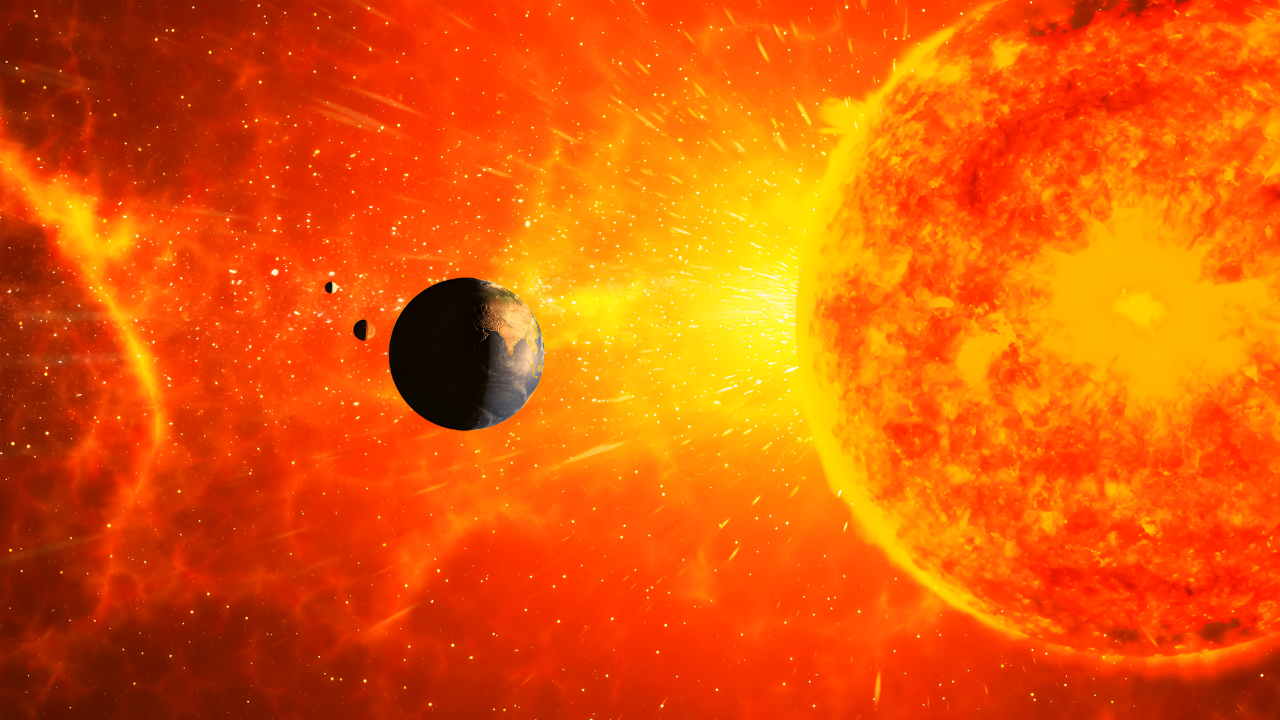
A sprawling and highly active sunspot complex is turning toward Earth just as a recent solar eruption sends a glancing blow our way, setting up several days of heightened space-weather risk and possible northern lights across North America. The active region known as AR4294 has grown so large and magnetically tangled that U.S. forecasters have split it into three numbered zones, underscoring its potential to fire off more powerful flares and particle clouds as the Sun approaches the peak of its current cycle.
Giant Sunspot Cluster and December’s X-Class Flare
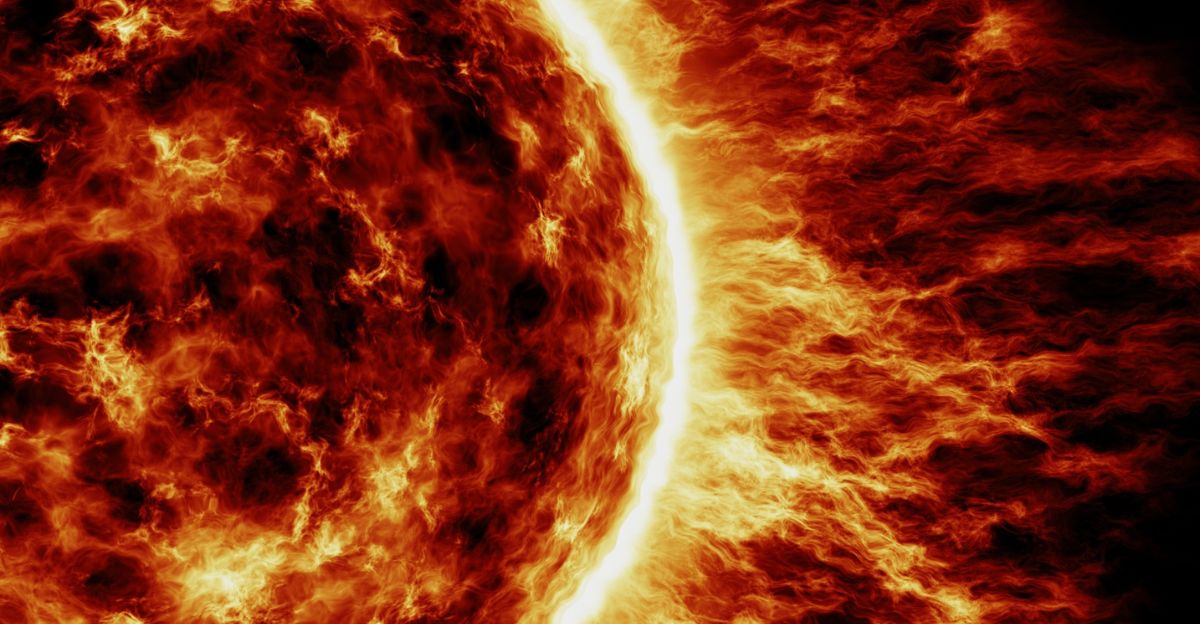
On the Sun’s visible disk, AR4294 stands out as a giant, explosive sunspot group with multiple magnetic cores twisted together. NOAA’s decision to classify it as three separate regions reflects how intricate and energetic its fields have become, the kind of configuration that often produces repeated strong eruptions. After disappearing on the far side of the Sun for several weeks, the complex rotated back into view facing Earth even larger and more complex than before, raising expectations for more frequent flaring.
The recent disturbance began just after the Sun’s return to the spotlight. In the early hours of December 1, at 2:49 GMT, a nearby region, AR4299, unleashed an X1.9-class flare. X-class events are the most powerful flares the Sun produces, with bursts of radiation that dwarf the energy released by nuclear weapons. NASA’s Solar Dynamics Observatory and the SOHO spacecraft recorded the flash and then tracked a vast cloud of charged particles, known as a coronal mass ejection, lifting away from the solar surface.
Blackout Over Australia and a Glancing CME Hit
The X1.9 flare immediately disturbed Earth’s upper atmosphere over the dayside of the planet, causing a strong shortwave radio blackout centered on Australia and Southeast Asia. For about half an hour, many high-frequency channels used by pilots and ship crews went dark or became unreliable. NOAA’s Space Weather Prediction Center classified the disturbance as an R3 event, a strong but not extreme level on its radio blackout scale. During the outage, aircraft and vessels relied on alternate frequencies or satellite-based systems until normal propagation returned.
Images from SOHO showed that the same eruption launched a large coronal mass ejection off the Sun’s northeast limb. Most of the expanding cloud is expected to miss Earth, but modeling suggests that part of it will brush past the planet. Even a glancing impact can disturb Earth’s magnetic environment enough to energize auroras and briefly affect some technologies. Because the cloud is striking at an angle and its speed and density evolve during its journey, forecasters can only narrow the arrival window to roughly two days rather than predict a precise hour.
Why a G2 Storm Watch Matters
In response to the incoming coronal mass ejection, NOAA has issued a G2, or moderate, geomagnetic storm watch for December 3–4. On the five-step G scale, G2 storms are strong enough to generate noticeable electric currents in long power lines and to drive auroras well beyond the Arctic. Grid operators in northern regions sometimes see additional surges in transmission systems during such disturbances and may make small operational adjustments to protect transformers and other equipment.
In Earth’s upper atmosphere, the storm can heat and expand the air, increasing drag on low-orbiting satellites and slightly shifting their paths. Navigation and timing systems such as GPS must then send signals through a turbulent ionosphere, which can temporarily blur positions by several meters. Farmers using precision guidance, survey crews, and logistics networks can all experience brief accuracy drops. At higher latitudes, shortwave and other radio services may become patchy until the disturbance subsides.
Aurora Chances for North America

While the event began with a communications outage over Australia, it could end with widespread skyglow across parts of North America. When a coronal mass ejection interacts with Earth’s magnetic field, energy and particles are funneled toward the poles, where they collide with atmospheric gases and produce the shifting bands of light known as auroras. During a typical G2 storm, the auroral oval often reaches around 50 degrees of geomagnetic latitude.
That potential viewing zone covers a large swath of the northern United States and southern Canada, including states such as Minnesota, Wisconsin, Michigan, New York, Vermont, New Hampshire, and Maine, along with nearby Canadian provinces and parts of the Dakotas. Up to 70 million people live within or near this belt and could have a chance to see green and sometimes purple curtains of light along the northern horizon under clear, dark skies. If the storm intensifies beyond initial forecasts, the auroral boundary could shift farther south, bringing possible sightings from major cities like Chicago or Boston.
Looking Ahead in an Active Solar Cycle
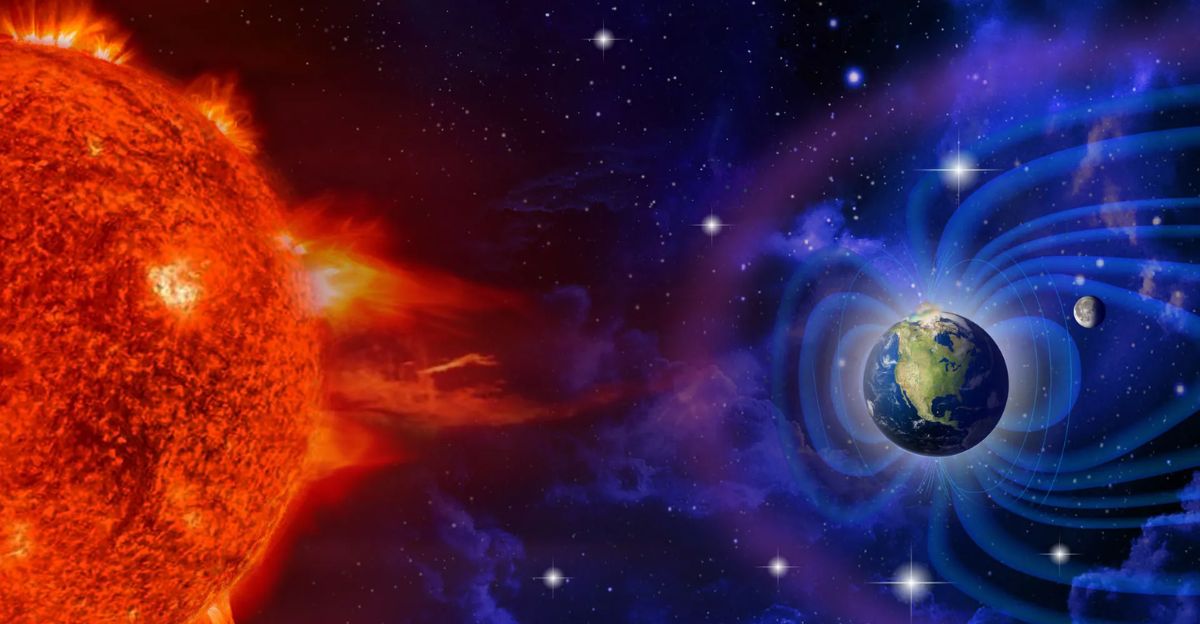
The same solar regions responsible for this week’s disruptions are likely to remain active in the days ahead. Forecasters expect more medium-strength M-class flares from AR4294, along with a smaller but real chance of another X-class burst as the sunspot cluster moves into a more direct line with Earth. Even flares that do not launch major coronal mass ejections can still trigger additional daytime radio blackouts in sunlit parts of the globe, prompting airlines and shipping operators to monitor solar conditions much like they track severe weather on Earth.
These developments fit a broader pattern: the Sun is heading toward the peak of Solar Cycle 25, expected around the middle of this decade, when large sunspots and frequent flares are more common. The current coronal mass ejection is forecast to only graze Earth, but as AR4294 continues to rotate, any new eruptions could send particle clouds directly along the Sun–Earth line and produce stronger storms. Space-weather specialists are watching closely, noting that the same solar forces that briefly silenced radios over Australia may soon illuminate skies across North America and, in the longer term, serve as a reminder of how closely modern technology is tied to conditions 150 million kilometers away.
Sources:
NOAA Space Weather Prediction Center – G2 Geomagnetic Storm Watch (Dec 3–4, 2025)
NASA – “Solar Cycle 25 Is Here. NASA, NOAA Scientists Explain What That Means”
Space.com – News article on the X‑class solar flare and AR4294
Manistee News / local space‑weather explainer on AR4294 & AR4299 and U.S. aurora odds