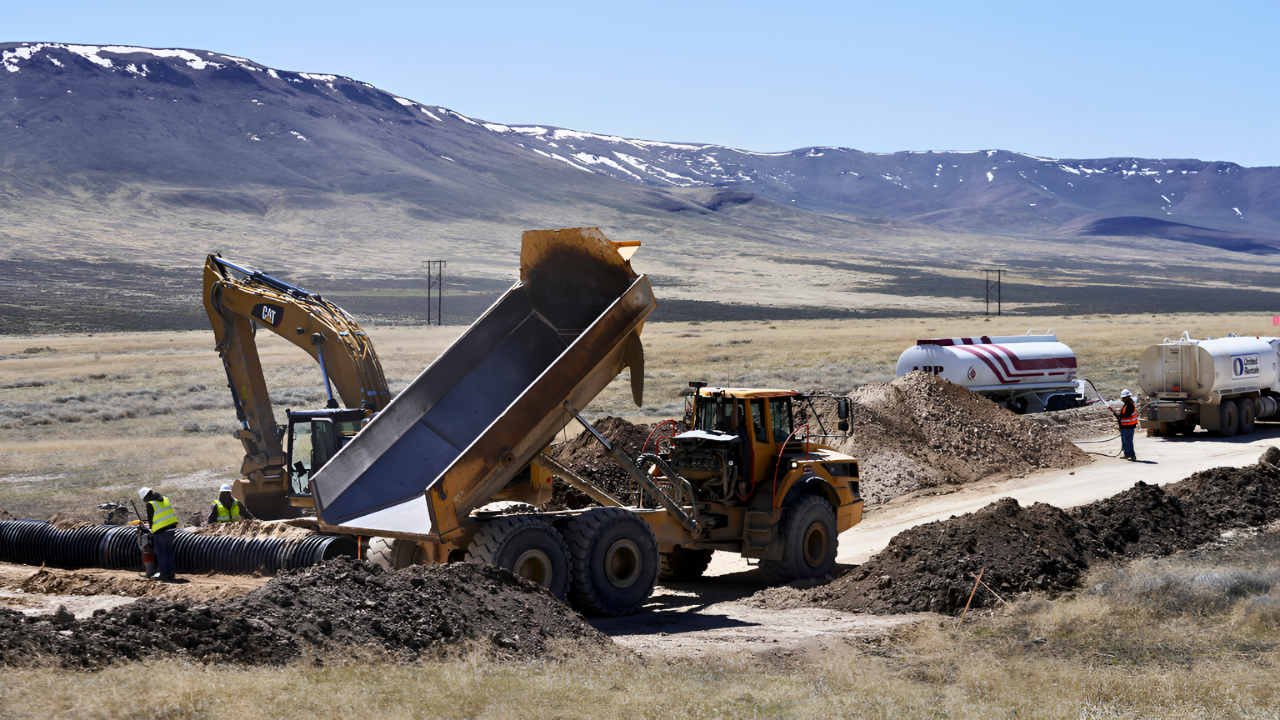
Inside the McDermitt Caldera, a 16‑million‑year‑old volcanic crater straddling the Oregon–Nevada border, geologists have identified one of the world’s largest known lithium clay deposits, estimated at roughly 20–40 million metric tons of lithium.
At prevailing lithium carbonate contract prices, analysts value this endowment at about 1.5 trillion US dollars. If commercially recoverable at scale, the caldera could supply a substantial share of global lithium demand for many years, directly supporting batteries for electric vehicles and grid‑scale energy storage.
Geological Origins: Supervolcano to Battery Metal
The McDermitt Caldera formed when a massive eruption caused the magma chamber beneath the region to collapse, creating a large, closed basin roughly 28 miles by 22 miles in extent. Over time, this basin hosted a lake that accumulated volcanic ash and fine sediments, which later lithified into claystones rich in lithium‑bearing minerals.
Subsequent hydrothermal fluids, exsolved from resurgent magmas at temperatures above about 300 degrees Celsius, further enriched these sediments, transforming Mg‑smectite into Li‑illite and concentrating lithium to unusually high levels. This combination of supervolcanic activity, closed‑basin sedimentation, and prolonged hydrothermal alteration explains why the caldera hosts an exceptional lithium resource.
From Geological Curiosity to Strategic Asset
Scientific work by Benson and colleagues in Science Advances found illite‑bearing sediments near Thacker Pass, in the southern McDermitt Caldera, with lithium contents averaging about 18,000 ppm in illite—roughly double typical smectite‑hosted deposits. Back‑of‑the‑envelope calculations using available drill data suggest that the broader caldera may contain on the order of 20–40 million metric tons of lithium, with a theoretical upper bound of about 120 million metric tons, although this is not a formal reserve estimate under reporting codes.
Because lithium is essential for modern rechargeable batteries across consumer electronics, electric vehicles, and renewable‑energy storage, such a deposit moves from geological curiosity to strategic asset the moment extraction becomes technically and economically viable.
Why This Deposit Matters Now
Industry and research forecasts converge on a steep rise in lithium demand through 2040, driven primarily by electric vehicles and stationary storage. Some analyses project that global lithium demand in 2040 could reach roughly six to eight times the total output of 2022, depending on adoption rates and battery chemistries.
Meeting these trajectories requires both expansion of existing operations and rapid development of new deposits, especially in jurisdictions with robust regulatory frameworks and infrastructure. In that context, a large, well‑studied resource on US soil—situated within a stable legal and logistical environment—has outsized significance for manufacturers and policymakers seeking to reduce supply chain risk.
Clay‑Hosted Lithium Can Be Mined
Clay‑hosted lithium extraction is technically challenging but not speculative; methods such as acid leaching and emerging processes like bioleaching have already been demonstrated at pilot and laboratory scales. Studies on lithium‑rich clays indicate that sulfuric‑acid leaching, optimized for temperature and particle size, can achieve high recovery rates, though process design must manage acid consumption and impurity removal.
Research on bioleaching of clay‑hosted lithium minerals shows that microbial systems can mobilize lithium under controlled conditions, potentially lowering energy intensity and chemical usage relative to conventional routes. These results do not guarantee that every clay deposit is economic, but they confirm that extracting lithium from claystones like those in McDermitt is a solvable engineering problem rather than a theoretical hope.
Constraints, Not Deal‑Breakers
The McDermitt region is ecologically and culturally sensitive, providing habitat for species such as sage‑grouse and supporting pronghorn and other desert fauna, while also containing sites of deep significance for nearby Indigenous communities. Local groups and tribal leaders have raised concerns about large‑scale mining, citing risks to wildlife, water resources, and sacred landscapes.
Environmental assessments highlight that claystone processing may involve complex steps, including acid leaching and tailings management, which require stringent controls to avoid contamination. These factors impose legitimate constraints on project design, timelines, and footprint, but they do not negate the existence or potential strategic value of the lithium resource itself; instead, they define the conditions under which development can proceed.
Federal Acceleration and Supply‑Chain Logic
Federal interest in lithium supply security has translated into policy support and streamlined procedures for some projects near the Nevada–Oregon border, including moves to accelerate permitting and exploration activities.
Reports describe proposals involving new access roads and hundreds of wells to further characterize and test the resource, reflecting the seriousness with which regulators and companies view the caldera’s potential. At the same time, international analyses emphasize that securing reliable lithium supply is crucial to achieving electric‑vehicle deployment targets and maintaining competitive domestic manufacturing. Within this broader framework, McDermitt’s scale and location position it as a plausible cornerstone of a North American battery materials strategy, subject to environmental review and commercial feasibility.
A Real, High‑Impact Discovery with Conditions
Taken together, peer‑reviewed geological work, independent resource calculations, and multiple news and technical analyses converge on a consistent picture: the McDermitt Caldera hosts one of the largest documented lithium clay deposits on record, with an indicative value around 1.5 trillion dollars at recent contract prices.
This does not imply that all of that lithium is currently recoverable as reserves, but it does establish a high‑confidence, exceptionally large resource in a strategically important location. The main uncertainties now lie in engineering choices, economic conditions, regulatory outcomes, and community consent—not in whether a massive lithium endowment exists beneath an ancient volcano on the Oregon–Nevada border.
Sources:
- “Lithium deposit valued at $1.5 trillion has been discovered inside a US volcano” – Earth.com
- “$1.5 trillion lithium deposit found in U.S. supervolcano crater” – Yahoo Finance
- “This Volcanic Crater In US Has Lithium Worth $1.5 Trillion” – NDTV
- “Geologic processes behind the $1.5 trillion McDermitt Caldera discovery” – Geoengineer.org
- “Hydrothermal enrichment of lithium in intracaldera illite-bearing claystones” – Science Advances (American Association for the Advancement of Science, AAAS)
- “Feds Accelerate Lithium Project On Nevada-Oregon Border” – Oregon Business Magazine